Welcome to the first installment of our journey through the ABCs of stock market lingo! Today, we’re starting right at the beginning with the letter A, and trust me, it’s going to be more interesting than your aunt’s advice about fixed deposits!
Remember when you first heard terms like ‘Assets’ and ‘Arbitrage’ being thrown around at family gatherings? While your cousin confidently discussed ‘Annual Returns’, you were probably nodding along, secretly wishing someone would explain what all this means in plain language. Well, you’re not alone – we’ve all been there, feeling like we’re trying to decode an ancient financial manuscript!
From ‘Ask Price’ (which has nothing to do with bargaining at your local market) to ‘Alpha’ (not the first letter of the Greek alphabet in this context!), we’re about to unravel these terms faster than your mom can spot a good deal at a sale. Whether you’re trading from Ahmedabad or Amsterdam, these fundamentals remain the same across the globe.
Think of this as your friendly neighborhood guide to stock market terms – no fancy jargon, no complicated explanations, just simple, clear information that won’t put you to sleep faster than your grandfather’s investment stories.
So, grab your favorite chai (or coffee, if that’s your thing), get comfortable, and let’s begin our adventure into the world of finance. Trust me, by the end of this post, you’ll be explaining these terms to your friends with the confidence of a seasoned stock market pro!
Ready to start your financial vocabulary journey? Let’s dive in!
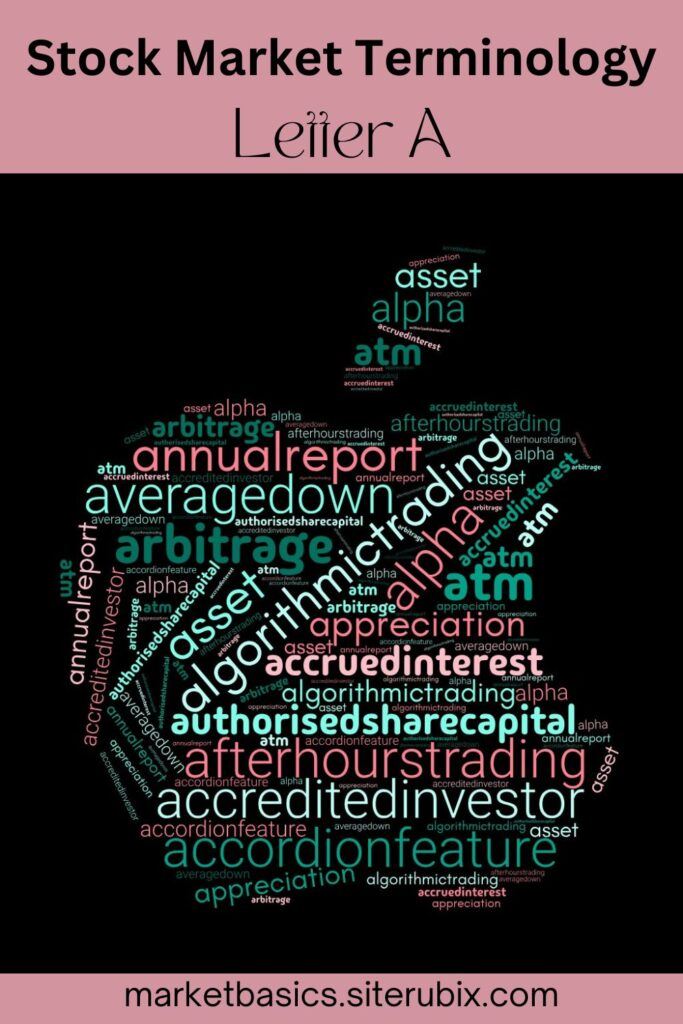
Common Terms
- Ask Price
- Definition: The lowest price a seller is willing to accept for a stock
- Also known as: Offer price
- Usage in context: “The ask price for Apple shares is $180.50”
- Asset
- Definition: Any item of economic value owned by an individual or corporation
- Types: Physical assets, financial assets, intangible assets
- Examples: Stocks, bonds, real estate, cash
- Alpha
- Definition: Measure of an investment’s performance compared to a benchmark
- Usage: Used to evaluate portfolio managers and investment strategies
- Formula: Investment Return – Benchmark Return = Alpha
- Arbitrage
- Definition: Simultaneous buying and selling of securities in different markets to profit from price differences
- Types: Pure arbitrage, risk arbitrage
- Example: Buying stock cheaper on one exchange and selling it higher on another
- Appreciation
- Definition: Increase in the value of an asset over time
- Related terms: Capital appreciation, currency appreciation
- Opposite: Depreciation
- Annual Report
- Definition: Yearly document providing company financial details to shareholders
- Key components: Financial statements, CEO letter, business overview
- Required by: SEC for public companies
- Assignment
- Definition: Transaction where an option seller must fulfill the contract obligations
- Context: Options trading
- Example: When a call option is exercised, the seller is assigned to deliver shares
- At The Money (ATM)
- Definition: When an option’s strike price equals the underlying asset’s market price
- Usage: Options trading terminology
- Significance: Affects option pricing and strategy selection
- Average Down
- Definition: Buying additional shares of a stock as the price falls to reduce average cost basis
- Strategy type: Investment technique
- Risk factor: Can increase exposure to losing investments
- Authorised Share Capital
- Definition: Maximum amount of share capital a company is allowed to issue
- Also known as: Registered capital
- Legal requirement: Specified in company’s articles of association
Less Common Terms
- Accrued Interest
- Definition: Interest earned but not yet paid or received
- Relevance: Bond trading and fixed-income securities
- Accredited Investor
- Definition: Individual or entity meeting specific income/net worth requirements for certain investments
- SEC requirements: $200,000 annual income or $1 million net worth
- Accordion Feature
- Definition: Provision allowing a borrower to increase the maximum limit of a credit line
- Usage: Corporate finance and lending
- Alligator Spread
- Definition: Complex options trading strategy with high transaction costs
- Risk level: High
- Usage: Advanced options trading
- Adjusted Cost Base
- Definition: Initial cost of an investment modified by various factors
- Factors: Reinvested distributions, return of capital
- Tax importance: Used to calculate capital gains/losses
Industry-Specific Terms
- American Depository Receipt (ADR)
- Definition: U.S.-traded certificate representing foreign company shares
- Purpose: Enables U.S. trading of foreign stocks
- Examples: Alibaba, Toyota
- Algorithmic Trading
- Definition: Using computer programs to automatically execute trades
- Also known as: Algo-trading, automated trading
- Components: Trading strategies, risk management, execution
- After-Hours Trading
- Definition: Trading that occurs after regular market hours
- Time: 4:00 PM – 8:00 PM EST (typical)
- Characteristics: Lower liquidity, higher volatility
And that wraps up our journey through the A’s of stock market terminology! From ‘Asset Allocation’ to ‘Ask Price’, we’ve navigated through some essential terms that every investor should know. Think of these terms as the aloo in your samosa – absolutely fundamental to the whole experience!
Just like learning any new language, mastering stock market terminology is a gradual process. Don’t feel overwhelmed if you need to revisit these terms a few times – that’s completely normal! Even Warren Buffett started somewhere, and I’m pretty sure he wasn’t born knowing what ‘Arbitrage’ meant.
Next up in our alphabetical adventure will be the B’s of stock market terms. Trust me, it’s going to be as exciting as finding out your favorite IPO is opening for subscription! Until then, keep these terms handy, practice using them in your investment conversations, and remember – every expert was once a beginner.
Have questions about any of these A-terms? Feel free to drop them in the comments below. Learning is always better when we do it together!
See you in the next post, where we’ll continue building your stock market vocabulary, one letter at a time!